If you’ve been thinking about board and train but wondering what your dog actually does for two to four weeks away from home, let me walk you through it.
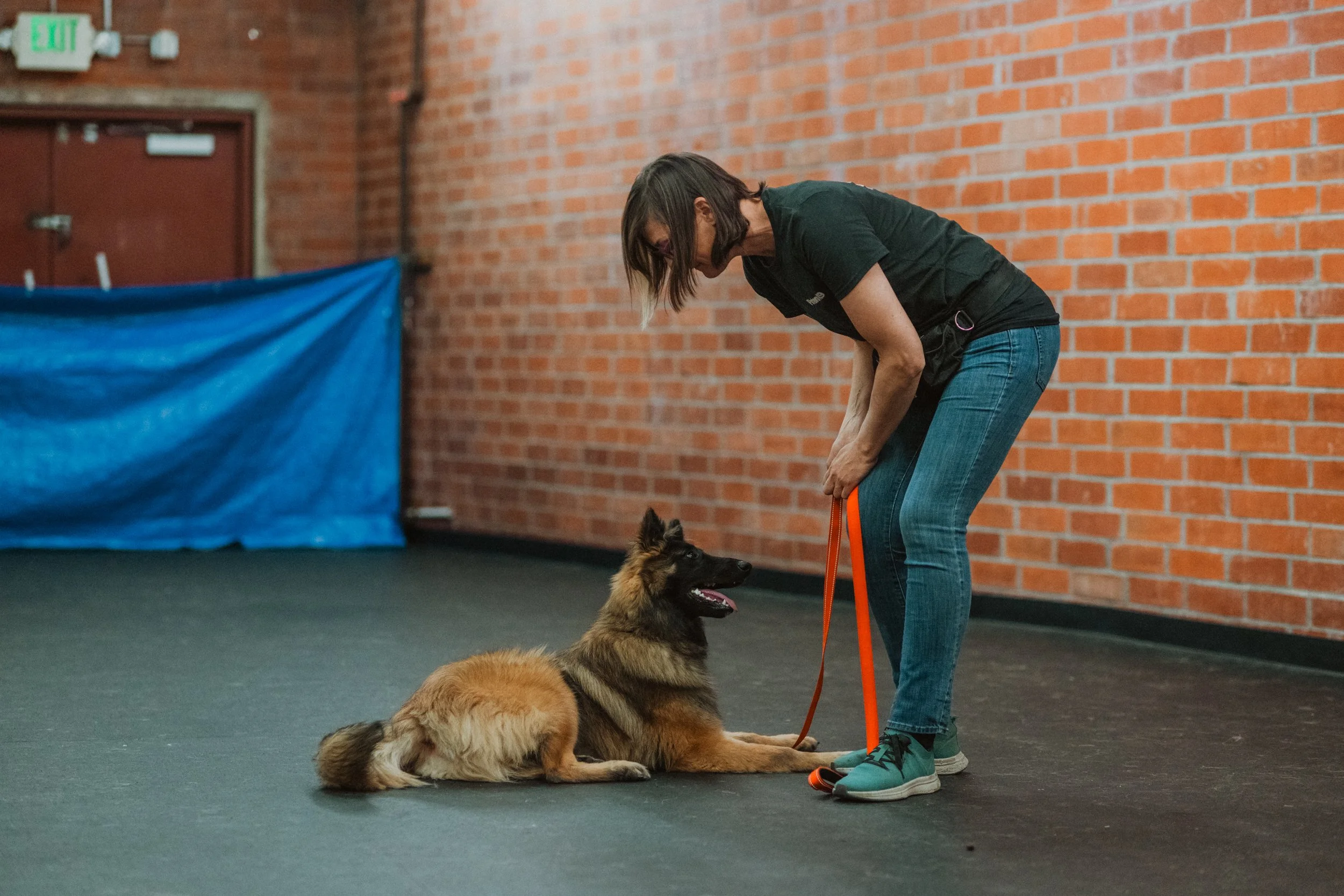
It’s Not What You Think
Board and train isn’t a dog hotel with occasional training sessions thrown in. It’s continuous skill rehearsal, multiple times a day, from the moment I get your dog out of the crate until bedtime.
Here’s the reality: every interaction is training. When your dog gets released from their crate, we’re working on impulse control before they even step outside. Before the leash goes on, they settle down. We work place bed skills, loose leash walking, heeling—both on and off leash—and foundational obedience. It’s not one session at 10 a.m. and then your dog hangs out. It’s purposeful repetition all day long.
What a Day Actually Looks Like
Morning: Your dog gets out of their crate, goes potty, and gets good exercise—either in our exercise yard or on the treadmill, depending on what they need.
Mid-Morning: Formal training session. This might happen in our training space, or we might take it on the road to proof behaviors in real environments where your dog actually lives.
Afternoon: Calm settles. Dogs go back into their crates or onto place beds. Mental and physical exercise means they actually want to rest, which is a skill in itself.
Evening: We restart the whole sequence, but with an emphasis on calmer exercises and activities so they wind down for the night.
That’s five to six days a week for two to four weeks straight. It’s a lot of repetition, and that repetition is exactly why board and train works.
The Real Cost (and What’s Included)
A two-week board and train with four private lessons is $2,500. A three-week board and train with two private lessons is $3,000. For dogs who have already been through my program, a one-week refresher board and train is $1,000. If you’d rather work one-on-one, a package of four private lessons is $550.
Here’s what you actually get:
Daily training and care for your dog
Updates every two to three days so you’re not wondering what’s happening
A go-home lesson where we review everything together
A follow-up lesson within two weeks of pickup (this is crucial—see below)
Two free group classes that you can attend to continue your dog’s progress
Which Dogs Do Well
The dogs that thrive in my board and train programs are already crate-trained. That’s the biggest predictor of success. If your dog isn’t used to sleeping in a crate, they can still come, but you need to tell me that upfront.
If your dog has separation anxiety, I can absolutely work with that—but it’s going to add at least one, possibly two extra weeks to the program, and the cost will reflect that. It’s not a surprise cost; we just need more time to build that foundation.
The dogs that really struggle during board and train are the ones that are very nervous and have low food drive, or dogs that have been free-fed their entire lives and don’t know how to work for food. Food motivation is a language, and some dogs have never learned it. We can teach it, but it takes time and patience.
Here’s Where You Come In
This is the part that matters most: what happens when your dog comes home depends almost entirely on you.
The Go-Home Lesson
When you pick up your dog, we spend time together. I show you how the tools work. We practice the behaviors together. I watch your handling—how you mark behaviors, how you time your rewards, where you might accidentally reward the wrong thing. I also talk about reward fading: how we can start moving toward intermittent rewards so your dog isn’t working for a treat every single time.
The Follow-Up Lesson (Two Weeks Later)
This is where I check in on reality. Are you actually using the tools? Are you marking the correct behaviors? Is your handling consistent with what we practiced? What new issues have popped up? (And they always do—that’s normal.)
The Hard Truth
If you pick up your dog and then don’t follow the plan, your dog will start reverting within a week. Sometimes faster. Board and train works because we repeat skills hundreds of times. If those reps stop, the learning fades. It’s not because your dog is stubborn or the training didn’t work—it’s because training is a practice, not a one-time fix.
When Board and Train Isn’t Right
I will tell you if board and train isn’t the right fit, and I’m going to be direct about it.
Board and train doesn’t work if you have unrealistic expectations about what it can do. Specifically, if you plan to pick up your dog and then continue doing all the same things that created the problems in the first place, we’re wasting everyone’s time and money.
Here’s an example: your dog jumps on guests because they’ve been allowed to jump on guests for three years. Board and train teaches them not to jump. But if guests come over and you let your dog jump again because “they’re so excited to see people,” your dog will start jumping again. That’s not a failure of the training—that’s a failure to change the environment.
Some of the challenges your dog faces can only be fixed by changing how your dog lives. Different rules, different management, different structures. If you’re not willing to be flexible and make those changes, board and train is going to feel like a waste of money.
The Real Value
Board and train works because it gives your dog intensive practice in a controlled environment, and it teaches you what consistency actually looks like. The follow-up lesson and group classes aren’t add-ons—they’re the difference between training that lasts and training that evaporates.
Your dog doesn’t need to live here forever. They need to learn skills and then have an owner who practices them. If you’re ready for that, board and train is one of the most powerful tools I have.
If you’re not ready yet, that’s okay too. But I’ll tell you straight up which one applies to you.
